
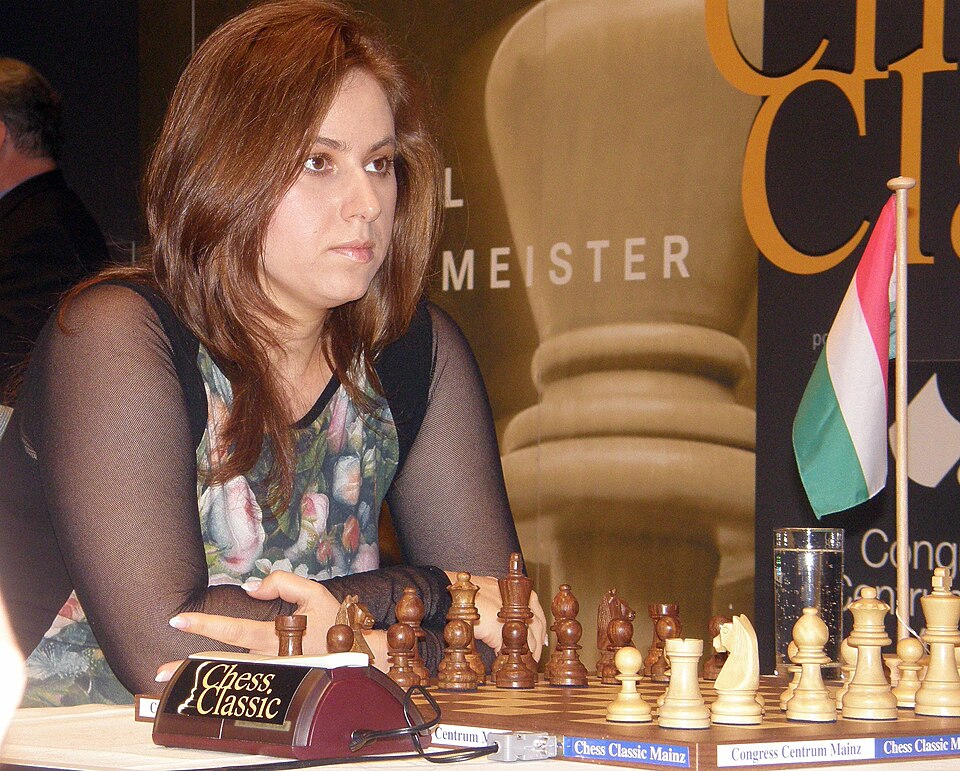
childhood
Born on 23 July 1976 in Budapest, Hungary, into a Jewish family.
Her father, László Polgár, had a radical educational philosophy: he believed that geniuses are made, not born, and that any healthy child could be turned into a genius with the right early training.
Judit's childhood was spent in a small, cramped Budapest apartment that doubled as a high-intensity chess laboratory. Her father lined the walls with over 10,000 chess books and index cards detailing every game ever played by the greats.
She and her sisters were homeschooled, with chess at the center of their education. Their mother sang them a lullaby: "One hundred roads are open to you."
Judit began playing chess at age 5. Her first international tournament victory came at age 9 in New York.
education
Judit was homeschooled as part of her father's "experiment" to prove that genius can be created through intensive early education.
Her education was entirely centered on chess, with daily training and study from a very young age.
She did not attend a conventional school, which she later acknowledged as an unusual but ultimately successful upbringing.
career
The greatest female chess player of all time and the only woman to have been ranked in the top 10 of the world's absolute chess players.
Became the No. 1 ranked woman in the world at age 12 in 1989.
Achieved the Grandmaster title in 1991 at age 15, breaking Bobby Fischer's record as the youngest ever Grandmaster at the time.
Defeated numerous World Champions, including Garry Kasparov, Anatoly Karpov, Boris Spassky, and Viswanathan Anand.
Reached her peak ranking of No. 8 in the world in 2005, the highest ever for a female player.
Won the World Rapid Championship and the World Blitz Championship in 2021, among many other titles.
She has since become an author, commentator, and founder of the Judit Polgar Method, which uses chess to help children develop key skills.
stories & anecdotes
Judit's father's experiment was controversial and drew attention from psychologists and educators worldwide.
She famously defeated Garry Kasparov in a game in 2002, a victory that made headlines around the world.
Unlike her sisters Susan and Sofia, Judit chose to compete primarily in men's tournaments from an early age, refusing to play in separate women's events.
She is known for her aggressive, attacking style and her fierce competitive spirit.
She has said: "I had to prove myself more than a boy."
quotes
"I had to prove myself more than a boy."
"Chess is a game of strategy, but it's also a game of life."
"My father believed that geniuses are made, not born. He proved it with us."
publications
Judit Polgar Teaches Chess 1: How I Beat Fischer's Record (2012) — her first instructional volume.
From GM to Top Ten: Judit Polgar Teaches Chess 2 (2013) — continues her rise to the top ten.
A Game of Queens: Judit Polgar Teaches Chess 3 (2015) — the final volume of her trilogy.
Master Your Chess with Judit Polgar (2022) — a comprehensive instructional work.
Play through Judit Polgar’s games
No published games are linked yet. When automation submits a PGN with this player’s slug, it will appear here automatically.
Editorial note: this profile was adapted from supplied research notes. Historical details and attributed quotations should be fact-checked before formal publication.