
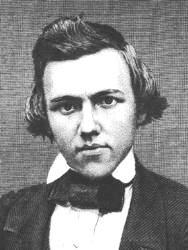
childhood
Born on 22 June 1837 in New Orleans, Louisiana, into a wealthy and distinguished family.
Learned chess by watching his father and uncle play. His uncle Ernest wrote: "The child has never opened a work on chess." He absorbed the game purely by observation and innate talent.
At age 13, he was already a strong player, defeating visiting masters, though he was "depressed in mind, and suffering in body" at the time.
By age nine, he was considered one of the best players in New Orleans.
education
Received a systematic education at Jefferson Academy in New Orleans, befitting the son of a gentleman.
Graduated from Spring Hill College in Mobile, Alabama, in 1855, distinguishing himself in several departments of study.
Studied law and earned his degree at age 19, but was too young to practice. He chose to devote himself to chess instead.
career
The first American chess phenomenon and the unofficial World Champion from 1858 to 1860. He is widely considered the greatest player of his era and one of the greatest natural talents in chess history.
Won the First American Chess Congress in 1857, defeating all challengers decisively. Out of about one hundred games against the strongest American players, he lost only three.
Traveled to Europe in 1858 and defeated every leading player, including Adolf Anderssen (the strongest European player) in a match 7–2 (with 2 draws). He also defeated Daniel Harrwitz and others.
His style was characterized by rapid development, open lines, and brilliant sacrifices. He is considered the father of the "Romantic" school of chess.
After returning to America in 1859, he largely withdrew from competitive chess, suffering from mental illness and paranoia. He died in 1884 at age 47.
stories & anecdotes
Morphy's famous Opera Game (1858) against the Duke of Brunswick and Count Isouard, played during a performance of Norma, is perhaps the most famous chess game ever played — a model of rapid development and sacrifice.
He was known as "The Pride and Sorrow of Chess" — pride for his genius, sorrow for his wasted potential and mental decline.
He was reportedly so dominant that he could play blindfolded against multiple opponents simultaneously, a rare feat in his time.
After his European triumph, he was celebrated in New York with a grand banquet, but he soon became reclusive and paranoid, believing people were trying to poison him.
quotes
"The ability to play chess is the sign of a gentleman. The ability to play chess well is the sign of a wasted life."
"Help your pieces so they can help you."
publications
Morphy's Games: A Selection of the Best Games Played by the Distinguished Champion — a collection of his games with annotations.
A First Book of Morphy by Frisco Del Rosario — uses Morphy's games to illustrate basic chess principles.
Play through Paul Morphy’s games
No published games are linked yet. When automation submits a PGN with this player’s slug, it will appear here automatically.
Editorial note: this profile was adapted from supplied research notes. Historical details and attributed quotations should be fact-checked before formal publication.