
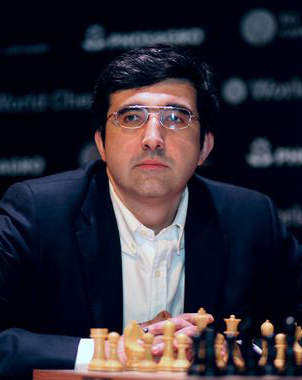
childhood
Born on 25 June 1975 in Tuapse, on the Black Sea coast of Russia, to a sculptor father and a music teacher mother.
Learned chess at age four from his father, joined a local chess club at five, and became Tuapse Champion at age seven.
At age eleven, his games fell into the hands of Mikhail Botvinnik, who recognized his talent and invited him to the Botvinnik-Kasparov school for gifted young players. Kramnik later said: "I couldn't get anywhere until I found myself, more or less by accident, in the Kasparov-Botvinnik School. That gave me possibilities."
education
Attended the Botvinnik-Kasparov chess school from age 11.
Later attempted university studies in Novgorod (foreign languages, then philosophy) but dropped out, famously generating a student newspaper notice: "Dear students, please don't follow the path of Vladimir Kramnik. Our country does need champions, but even more so it needs philosophers and foreign language specialists."
He noted: "I tried to receive higher education, but it was too difficult for me to combine chess with serious studies. Curiously enough, he dropped out of college right after becoming world champion."
career
Fourteenth World Chess Champion, defeating Garry Kasparov in London in 2000 with a score of 8.5–6.5, without losing a single game.
Won the World Under-18 Championship in 1991 and a gold medal at the 1992 Men's Chess Olympiad at age 16, scoring 8.5/9.
Held the Classical World Championship title from 2000 to 2007; unified the title in 2006 by defeating Veselin Topalov.
Lost the title to Viswanathan Anand in 2007.
Known for his solid positional understanding, endgame precision, and pragmatic, tenacious style.
Diagnosed with ankylosing spondylitis, which occasionally caused him to withdraw from tournaments.
Retired from classical chess in January 2019.
stories & anecdotes
Kramnik's 2000 match victory over Kasparov is considered one of the greatest upsets in chess history; he neutralized Kasparov's aggressive play with deep preparation and flawless technique.
He famously drew an 8-game match with Deep Fritz in 2002 (2 wins, 2 losses, 4 draws) and lost a rematch in 2006 (0 wins, 2 losses, 4 draws).
His quote on art and chess: "Art and chess are just different fields, in which the same poetry finds expression."
quotes
"Art and chess are just different fields, in which the same poetry finds expression."
"You can win a hundred tournaments, but the world champion is the one who wins the world championship."
"I am ready for a civilized dialogue with FIDE."
publications
Kramnik: My Life and Games (with Iakov Damsky, 2000) — his first book; annotates 100 of his best games and describes his unusual childhood.
Positional Play — instructional work.
Mikhail Tal I-III (2017 Games) — co-authored.
Play through Vladimir Kramnik’s games
No published games are linked yet. When automation submits a PGN with this player’s slug, it will appear here automatically.
Editorial note: this profile was adapted from supplied research notes. Historical details and attributed quotations should be fact-checked before formal publication.